
Compliance has a reputation problem in the SME finance world. Many lenders treat it as a cost center to minimize, rather than a capability worth investing in. That reputation exists for a historical reason: good KYC and fraud infrastructure has been expensive. It was built for banks with compliance budgets that dwarf an entire SME lender’s operating cost. AI is changing that equation, making regulatory-grade compliance tooling accessible to much smaller institutions.
The Real Cost of Manual KYC
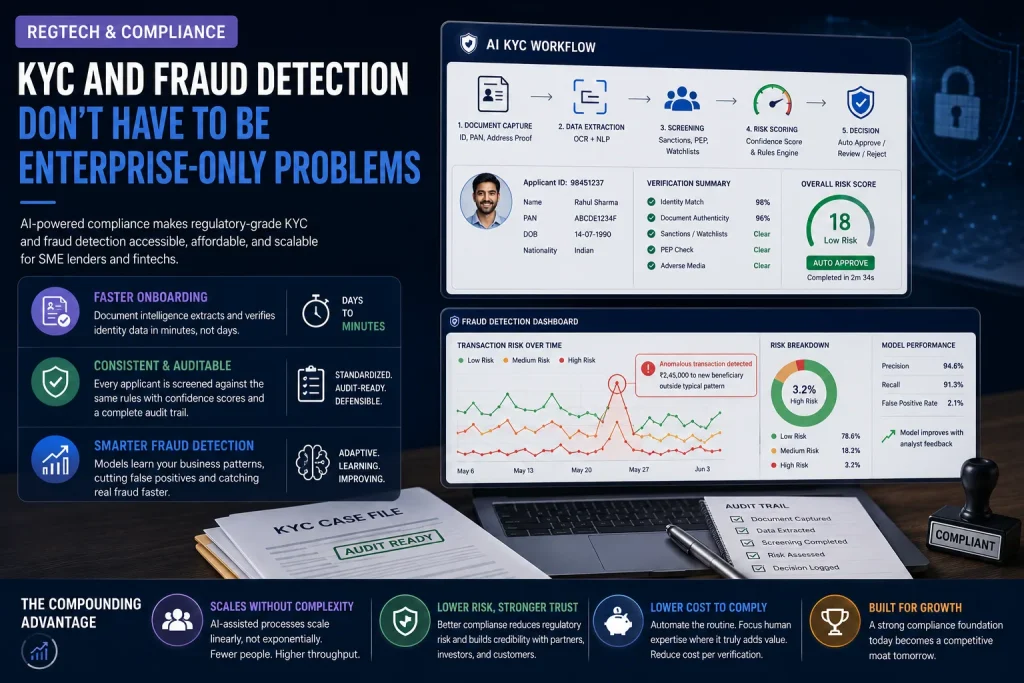
Manual identity verification isn’t just slow — it’s inconsistent. Two reviewers looking at the same document set can reach different conclusions. That inconsistency is exactly what regulators flag during audits. Document intelligence systems built on OCR and NLP extract identity fields, cross-reference sanctions and PEP lists, and generate a standardized, auditable case file for every applicant. This removes reviewer-to-reviewer variance from the equation entirely.
The practical benefit isn’t just speed, though onboarding time typically drops from days to minutes. It’s consistency: the system screens every applicant against the same criteria and attaches a confidence score to every extracted field. Low-confidence cases route to a human reviewer; high-confidence cases move through automatically. That triage model — AI handles the routine, humans handle the ambiguous — follows the same pattern. It’s what makes compliance AI defensible to regulators, rather than a black box they’ll push back on.
Fraud Detection That Learns Your Business, Not Someone Else’s
Generic fraud detection suites catch fraud patterns across thousands of unrelated businesses. That means they’re tuned for the average case — not for a specific regional payment gateway or microfinance lender’s actual transaction behavior. That mismatch shows up as false positives: the system flags and delays legitimate transactions because they don’t match a generic pattern library.
Adaptive fraud models solve this by training on a business’s own transaction history. Tune a gradient-boosted or anomaly-detection model to a specific institution’s typical transaction sizes, geographies, and timing patterns, and it will flag genuine anomalies far more precisely than an off-the-shelf rules engine. These models also improve through analyst feedback — marking false positives, confirming true fraud. As a result, the system gets sharper the longer it runs, rather than staying static.
The Compounding Advantage of Getting Compliance Right Early
There’s a strategic angle here that’s easy to miss. Institutions that build strong KYC and fraud infrastructure early aren’t just reducing risk — they’re building a foundation that scales. Manual compliance processes get exponentially harder to manage as transaction volume grows. AI-assisted processes, by contrast, scale roughly linearly with far less added headcount. For a growing SME fintech, that’s the difference between compliance becoming a bottleneck at scale or staying a manageable, well-understood cost.