
AI in Wealth Management: From Static Reports to Conversational Portfolio Intelligence
For years, portfolio reporting in wealth management followed the same pattern: a client asked a question, a relationship manager pulled data from multiple systems, and a few hours or even days later, an answer arrived — often as a static PDF.
That workflow made sense when portfolio data lived in disconnected systems and every answer required manual assembly. However, it makes much less sense today.
AI in wealth management is changing how firms deliver portfolio information, support clients, and scale research. Instead of waiting for a manually prepared report, clients and relationship managers can increasingly interact with portfolio data through conversational interfaces.
The key difference is not simply automation. It is the ability to provide fast, grounded, and source-backed answers.
From Static Reports to Grounded, Conversational Answers
One of the biggest challenges when applying AI to wealth management is accuracy.
Clients cannot rely on an AI assistant that invents portfolio values, performance figures, or investment information. Therefore, the system needs access to trusted data and clear controls around what it can answer.
This is where Retrieval-Augmented Generation (RAG) becomes valuable.
A RAG-based system can index a firm’s actual holdings data, factsheets, portfolio reports, and approved market commentary. When a user asks a question, the system retrieves relevant information first and then generates an answer based on those sources.
The response can also include citations that point back to the underlying documents or data.
For example, a client could ask:
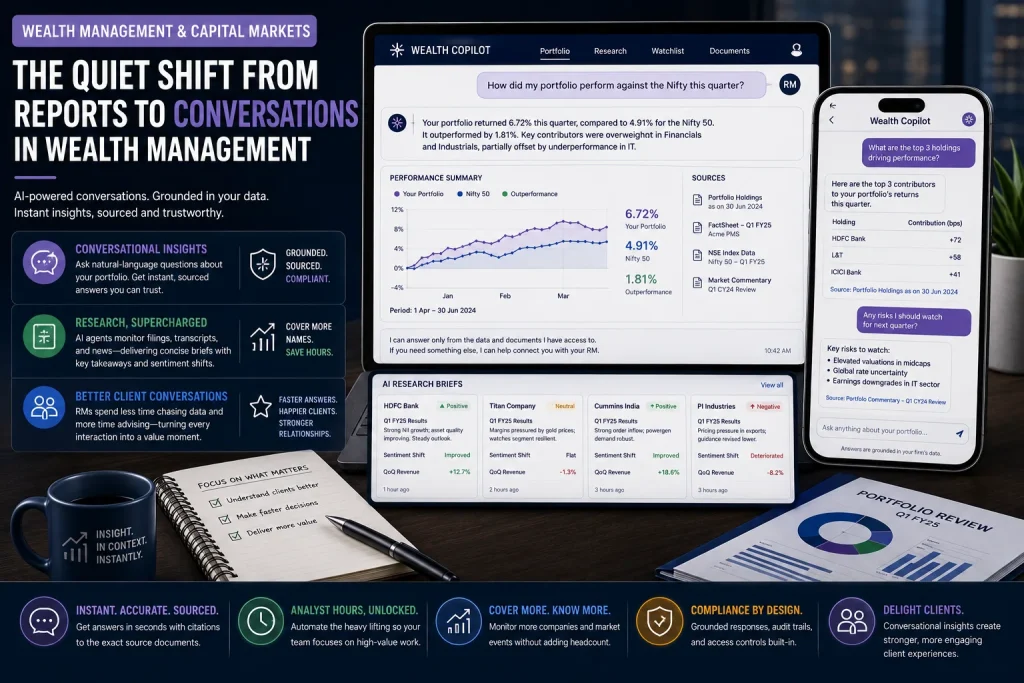
“How did my portfolio perform against the Nifty this quarter?”
Instead of producing a generic market-based estimate, the system can retrieve the relevant portfolio and benchmark data and provide a grounded response.
Just as importantly, a well-designed system knows when not to answer.
If the available data does not support a question, the assistant can respond that the information is unavailable rather than creating a plausible-sounding figure.
That guardrail is critical. It separates a useful, controlled wealth management tool from an impressive AI demo that cannot be trusted with real client conversations.
Why Grounding Matters for AI in Wealth Management
Generative AI is good at producing natural language. However, natural language alone is not enough for financial use cases.
Wealth management firms need answers that connect directly to trusted information sources.
A grounded AI workflow can help provide:
- Portfolio performance information
- Holdings and allocation details
- Benchmark comparisons
- Fund factsheet information
- Approved market commentary
- Research-based portfolio insights
The IBM overview of Retrieval-Augmented Generation explains how RAG connects language models with external knowledge sources.
For wealth managers, this approach creates a useful balance between conversational AI and controlled information retrieval.
Research at the Speed Markets Actually Move
The transformation is not limited to client-facing portfolio questions.
Research teams face another persistent bottleneck: there are only so many analysts and only so many hours available to review filings, listen to earnings calls, analyze market developments, and produce timely summaries.
For smaller equity research and advisory firms, this directly limits how many companies they can meaningfully cover.
AI-driven research summarization can change that equation.
An AI research agent can monitor filings, earnings transcripts, and relevant news for a defined watchlist. It can then generate concise briefs that highlight important developments, sentiment changes, and quarter-over-quarter differences.
The objective is not to replace analyst judgment.
Instead, AI removes the bottleneck between:
“The filing was released” → “The analyst has a usable summary.”
That can give research teams more time to interpret the information, challenge assumptions, and develop investment insights.
The Coverage Advantage for Boutique Firms
Consider a boutique advisory firm tracking 100 companies.
Without automation, analysts may need to manually review a large volume of filings, earnings materials, and market updates. As the watchlist grows, maintaining timely coverage becomes increasingly difficult.
With AI-assisted research workflows, the initial review can happen automatically.
The agent can identify relevant documents, summarize key changes, compare the latest quarter with previous periods, and highlight areas that may require analyst attention.
As a result, analysts can spend more time on the companies and developments that matter most.
This does not guarantee that a firm will cover three times as many companies. However, it can significantly reduce the time spent on repetitive information gathering and first-pass analysis.
What This Means for Smaller Wealth & Research Firms
Large financial institutions have invested in sophisticated research and reporting infrastructure for years.
Historically, comparable capabilities required significant technology budgets, specialist teams, and long implementation cycles.
That barrier is changing.
Today, RAG-based conversational tools, AI research summarization, and API-driven financial data integrations can give smaller firms access to capabilities that were previously difficult to build internally.
For boutique wealth managers and research firms, this creates an opportunity to compete on speed, accessibility, and client experience, rather than infrastructure size alone.
AI Can Give Relationship Managers More Time
The value of AI in wealth management is not limited to giving clients a chatbot.
Relationship managers can use the same technology internally.
Before a client meeting, an RM could ask:
- What drove this portfolio’s performance this quarter?
- Which holdings contributed most to the change?
- How did the portfolio compare with its benchmark?
- What are the latest developments affecting these holdings?
- Which client questions are likely to require additional research?
Instead of searching across multiple systems, the RM can start with a conversational query and review the supporting sources.
This can reduce preparation time while giving the RM more time to focus on the client relationship itself.
A New Model for Client Servicing
The traditional model is largely linear:
Client Question → RM Research → Data Collection → Report → Client
An AI-enabled model can be much more immediate:
Client Question → AI Retrieval → Grounded Answer → Source Citation
The RM does not disappear from the process. Instead, the RM becomes more focused on interpretation, advice, and relationship management.
That distinction matters.
The strongest implementations of AI in wealth management should augment professionals rather than attempt to replace them.
What Firms Need to Get Right
AI can create significant value, but implementation quality matters.
A wealth management firm should consider several factors before deploying a client-facing AI system.
Data Quality
The assistant is only as reliable as the information it can access. Portfolio, holdings, benchmark, and research data must be current and correctly structured.
Source Control
Firms should define which documents and systems the AI can use when generating client-facing answers.
Citations
Important answers should link back to the underlying source wherever practical. This gives users a way to verify the information.
Guardrails
The system should know when information is unavailable. A clear “data not available” response is better than an unsupported financial figure.
Human Oversight
Client-facing financial information may require human review depending on the use case, regulatory environment, and firm’s policies.
The Opportunity for Smaller Firms
The biggest opportunity may not be replacing existing wealth management infrastructure.
Instead, smaller firms can add an intelligent layer on top of the systems they already use.
Portfolio systems continue to manage portfolio data. Document repositories continue to store reports and factsheets. Research systems continue to provide market information.
AI can connect these sources through a conversational interface.
That means firms can improve the client experience without necessarily rebuilding their entire technology stack.
The Next Generation of Wealth Management
The future of portfolio reporting is unlikely to be defined by better PDFs alone.
Clients increasingly expect information to be accessible, immediate, and easy to understand. Relationship managers need the same advantage when preparing for meetings and responding to questions.
At the same time, research teams need ways to process growing volumes of information without growing headcount at the same rate.
AI in wealth management addresses both challenges.
RAG-based portfolio assistants can provide grounded, cited answers. AI research agents can summarize filings and earnings developments. Together, these tools can reduce repetitive information work while giving financial professionals more time for judgment, advice, and client relationships.
For smaller wealth management and research firms, that creates a meaningful opportunity.
The firms that adopt these capabilities thoughtfully will not simply save analyst hours. They can deliver a faster, more accessible, and more intelligent client experience — capabilities that were once largely available only to much larger institutions.
The shift is already underway: from static reports and manual research toward conversational, grounded, AI-powered financial intelligence.