
AI KYC Document Intelligence: Faster Compliance & Onboarding
Vertical: Compliance & Onboarding
Tagline: Verify identity documents in minutes, not days.
AI KYC document intelligence helps financial businesses automate document review, identity verification, and compliance checks during customer onboarding. Instead of relying entirely on manual reviews, the system extracts information from documents, validates key fields, checks sanctions and PEP data, and routes unclear cases to human reviewers.
The Problem: Manual KYC Slows Down Onboarding
KYC processes often require teams to review identity documents, address proofs, tax documents, and business records. When teams handle these checks manually, onboarding can become slow and inconsistent.
In addition, different reviewers may interpret documents differently. This can make quality control harder and create challenges during audits.
At the same time, regulated businesses cannot simply remove compliance checks to speed up onboarding. They need a process that improves efficiency while maintaining appropriate controls.
An AI KYC document intelligence solution addresses this challenge by combining document processing, field validation, screening, and human review in one workflow.
Key Features
Automated Document Data Extraction
The system extracts information from identity and business documents using OCR and natural language processing.
It can process documents such as:
- Identity documents
- Address proofs
- PAN documents
- GST documents
- Business registration records
- Other onboarding documents
For example, Amazon Textract can detect and analyze text, forms, tables, and other document elements. Google Cloud Document AI also provides document processing capabilities that convert unstructured documents into structured data.
Automated Sanctions and PEP Screening
The system can cross-reference extracted identity information against connected sanctions and PEP data sources.
This helps compliance teams identify potential matches for further review. For example, the OFAC Sanctions List Search provides a searchable source for U.S. sanctions lists.
However, screening results should support compliance workflows rather than replace appropriate human judgment.
Confidence Scoring
Not every document is clear. Poor image quality, unusual layouts, or missing information can affect extraction accuracy.
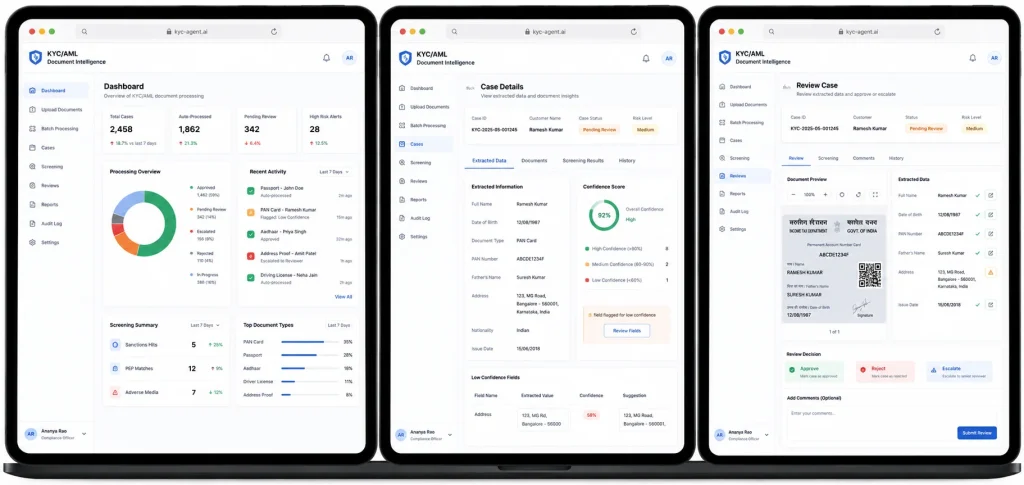
Therefore, the system assigns confidence scores to extracted fields. When confidence falls below a defined threshold, the case can automatically move to a reviewer.
This allows teams to focus their attention on documents that need additional investigation.
Audit-Ready Case Files
The platform keeps relevant documents, extracted information, screening results, reviewer actions, and case outcomes together.
As a result, compliance teams can create structured case files for internal reviews and regulatory audits.
Role-Based Workflows
The platform provides focused tools for different users:
- Onboarding Team: Bulk document upload and batch processing.
- Compliance Officer: Screening results, risk indicators, and case files.
- Reviewer: Approve, reject, or escalate cases from a centralized dashboard.
How AI KYC Document Intelligence Works
The workflow is designed to automate repetitive checks while keeping human reviewers involved when needed.
- Upload documents: The client uploads identity, address, and business documents.
- Extract information: The AI system reads the documents and extracts relevant fields.
- Validate information: The system checks extracted fields for completeness, consistency, and expected formats.
- Run screening checks: Extracted identity information is checked against connected sanctions and PEP data sources.
- Score confidence: The system identifies fields or cases that require additional review.
- Route exceptions: Low-confidence or potentially risky cases move to a reviewer dashboard.
- Create the case file: Approved cases generate a structured compliance record for future reference.
Why Automated KYC Matters
Customer onboarding is often one of the first operational bottlenecks for financial businesses. As application volumes increase, manual document review can consume significant team capacity.
Furthermore, compliance teams need consistent processes. The Financial Action Task Force (FATF) emphasizes customer identification and verification using reliable, independent documents, data, or information as part of customer due diligence.
AI can help organize these activities into a repeatable workflow. It can extract information faster, highlight exceptions, and give reviewers a consistent place to investigate potential issues.
Most importantly, automation does not have to mean removing people from the process. Instead, the system can handle routine document processing while reviewers focus on unclear, unusual, or higher-risk cases.
Technology Behind the Solution
A typical AI KYC document intelligence architecture can combine document AI, natural language processing, screening integrations, and workflow automation.
The technology stack can include:
- AWS Textract or Google Cloud Document AI for document processing
- spaCy or transformer-based NER models for entity extraction
- Sanctions and PEP data API integrations
- FastAPI for backend services
- PostgreSQL for structured KYC data
- React for reviewer and compliance dashboards
For example, AWS Textract supports document text detection and analysis, including forms and tables. Meanwhile, Google Document AI is designed to transform unstructured document information into structured data for downstream applications.
Why Choose AI KYC Document Intelligence?
A modern KYC workflow should do more than extract text from documents. It should connect extraction, validation, screening, review, and audit trails.
With an AI-powered workflow, businesses can:
- Reduce repetitive manual document checks
- Process larger onboarding volumes
- Identify unclear information earlier
- Standardize reviewer workflows
- Maintain structured compliance records
- Give compliance teams better visibility into exceptions
For a deeper look at this solution, explore Anthrobet’s AI KYC & AML Document Intelligence.
Ideal For
AI KYC document intelligence is particularly useful for:
- Brokerages
- Payment startups
- Lending platforms
- Fintech companies
- Digital financial services providers
- Businesses processing high customer onboarding volumes
From Manual KYC to Intelligent Compliance Operations
KYC does not need to rely entirely on manual document review.
Instead, businesses can combine AI-powered extraction with validation, sanctions screening, confidence scoring, and human review. This creates a faster and more structured onboarding process without removing important compliance controls.
As onboarding volumes grow, the same workflow can scale with the business. At the same time, reviewers can focus their time on cases that genuinely require human attention.
The goal is simple: verify documents faster, identify exceptions earlier, and create a more consistent compliance workflow.