
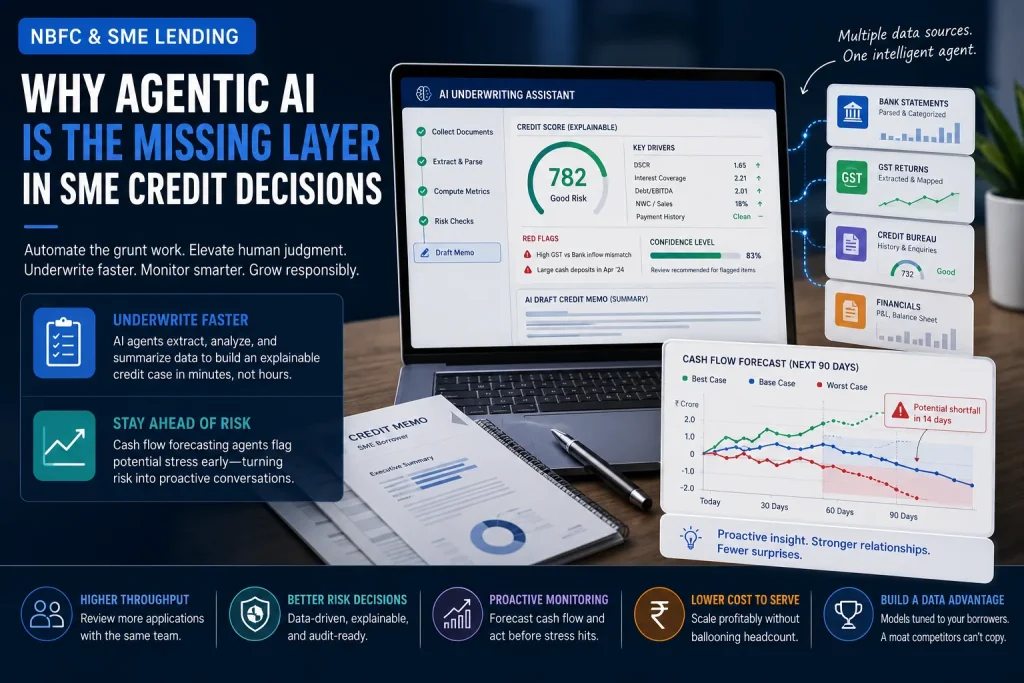
For most NBFCs and SME-focused lenders, the biggest bottleneck isn’t capital — it’s throughput. Agentic AI underwriting solves exactly this problem. A credit analyst can only review so many bank statements, GST filings, and bureau reports in a day. Every hour spent assembling a credit memo is an hour lost from evaluating the next applicant. As loan volumes grow, this manual process caps how fast a lending business can scale.
The Bottleneck Agentic AI Underwriting Solves
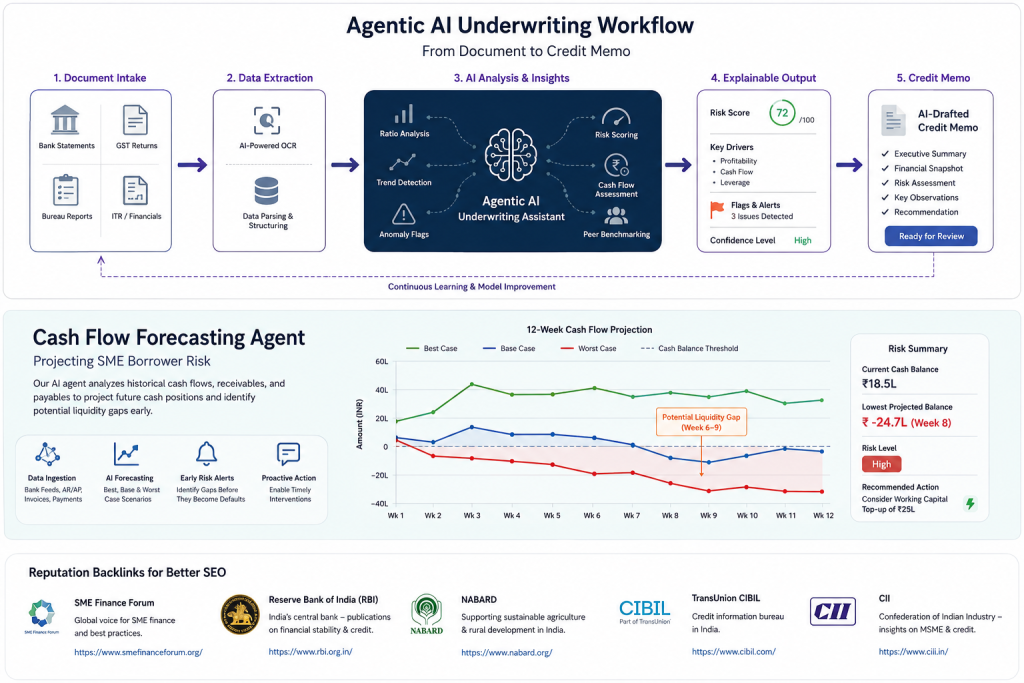
Traditional underwriting workflows look roughly the same across most small lenders. Analysts collect documents, extract financial data by hand, calculate ratios, cross-check bureau history, and write up a memo for approval. Each step matters, but almost none of it requires human judgment — it requires human time. That distinction matters: it’s exactly the kind of repetitive, structured work that agentic AI systems can automate.
An agentic AI underwriting assistant doesn’t replace the credit committee’s judgment. Instead, it compresses the preparatory work. It parses bank statements and GST returns into structured financials, computes key ratios, flags inconsistencies, and drafts a memo with an explainable risk score. The analyst’s job shifts from data assembly to decision-making — reviewing a pre-built case rather than building one from scratch.
Explainability is non-negotiable here. A credit decision that can’t be traced to specific, auditable factors is a liability, not an asset. This holds true for both internal risk management and regulatory scrutiny. Any agentic AI underwriting system worth deploying needs to show its work: which ratios drove the score, which documents raised flags, and where confidence is too low for automated approval.
Forecasting the Next Problem Before It Happens
Underwriting solves the approval problem. But SME lenders face a second, quieter challenge: portfolio-level cash flow visibility. Once a loan is disbursed, most lenders have limited insight into a borrower’s cash position — until a payment is missed. See how cash flow forecasting agents close this gap → (link to your existing cash-flow-forecasting post)
Cash flow forecasting agents close that gap directly. They ingest a borrower’s receivables and payables data — or a lender’s own treasury data — and project cash positions forward across best, base, and worst-case scenarios. This flags gaps before they become defaults. For a relationship manager, this turns a reactive collections process into a proactive advisory conversation. Instead of chasing a missed payment, they offer a working-capital top-up two weeks before the borrower needs it.
Why This Matters for Smaller Lenders Specifically
Large banks have built (or bought) sophisticated underwriting and risk infrastructure for years. SME and mid-market lenders typically haven’t had access to comparable tooling at a price point that fits their loan book size — a gap the SME Finance Forum has tracked closely at a global level. Agentic AI changes that math. A lean team can now underwrite and monitor a portfolio with a fraction of the headcount previously required, without sacrificing the explainability regulators expect.
The lenders who adopt agentic AI underwriting earliest won’t just process loans faster. They’ll build risk models tuned to their own borrower base — creating a data advantage that’s genuinely hard for slower-moving competitors to replicate.