
Investment banking and back-office finance sit at opposite ends of a firm’s day-to-day work. One is client-facing and deal-driven. The other is internal and process-driven. But they share a common failure mode: both are full of structured, repetitive work that consumes senior time without requiring senior judgment. That’s precisely the gap agentic AI is starting to fill.
The Pitch Deck Problem
Ask any investment banking associate what eats the most time in a live deal process, and “building the deck” is a near-universal answer. Pulling comparable company data, building precedent transaction tables, drafting valuation summaries, and writing narrative slides — all of this is necessary work. But it’s also highly templated. The inputs change; the structure and logic largely don’t.
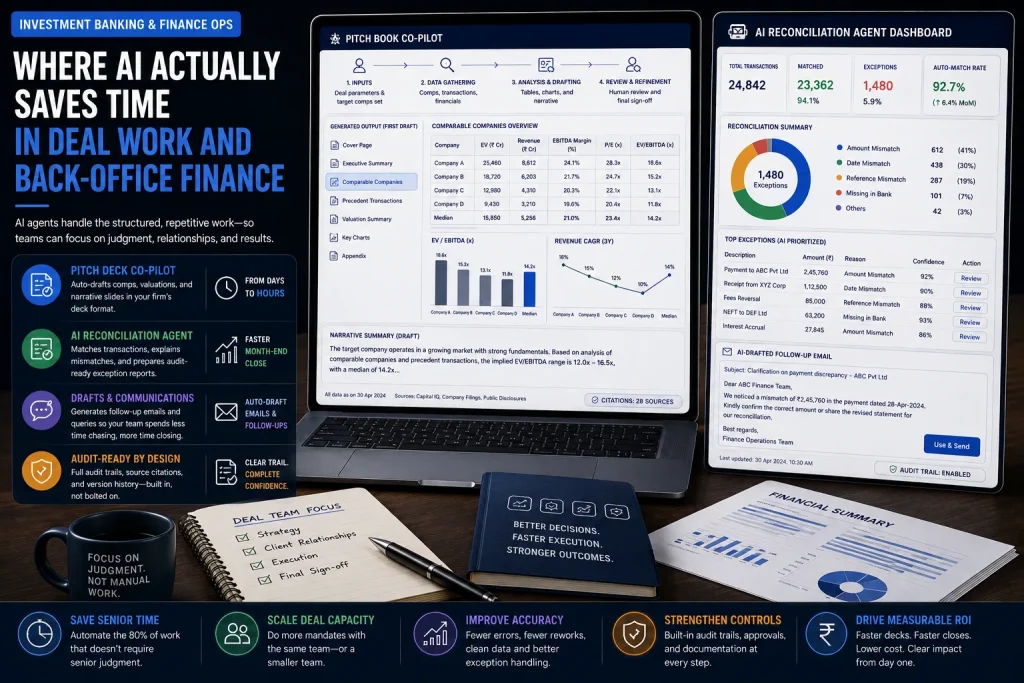
An AI pitch book co-pilot handles exactly that templated layer. Given deal parameters and a target comps set, it pulls the relevant data, drafts comps and valuation tables, and generates first-pass narrative slides in the firm’s own deck format. Nobody suggests a first draft should go to a client untouched. But compressing a multi-day associate build into a same-day first draft changes what a small deal team can take on. A boutique IB with three associates can suddenly run point on more live mandates at once. The mechanical assembly work no longer scales linearly with headcount.
The Unglamorous Work That Actually Moves the Needle
While pitch decks get the attention, reconciliation is arguably where AI delivers the fastest, most measurable return in finance operations. Every finance team spends real time each month on this — whether at an investment bank, an NBFC, or a payment platform. Teams match ledgers against bank statements, chase down mismatches, and document exceptions for auditors.
An AI reconciliation agent automates the matching itself. It uses fuzzy logic to handle the amount, date, and reference mismatches that make perfect matching rare in practice. The system routes genuine exceptions to a dashboard with a full audit trail, and it can even draft the follow-up communication needed to resolve a discrepancy with a counterparty. This isn’t a glamorous use of AI. But it’s one of the clearest ROI cases in the entire fintech AI landscape: less manual matching, faster month-end close, and a cleaner audit trail by default.
The Common Thread
What connects pitch book generation and reconciliation is the same principle that applies across every AI use case in this space. AI should absorb the structured, repetitive layer of work. Humans retain judgment, client relationships, and final sign-off. Deal teams still own the strategy behind a pitch; finance teams still own the final reconciliation sign-off. What changes is how much of that surrounding, mechanical work a person has to do before judgment can even be applied (london stock exchange)