

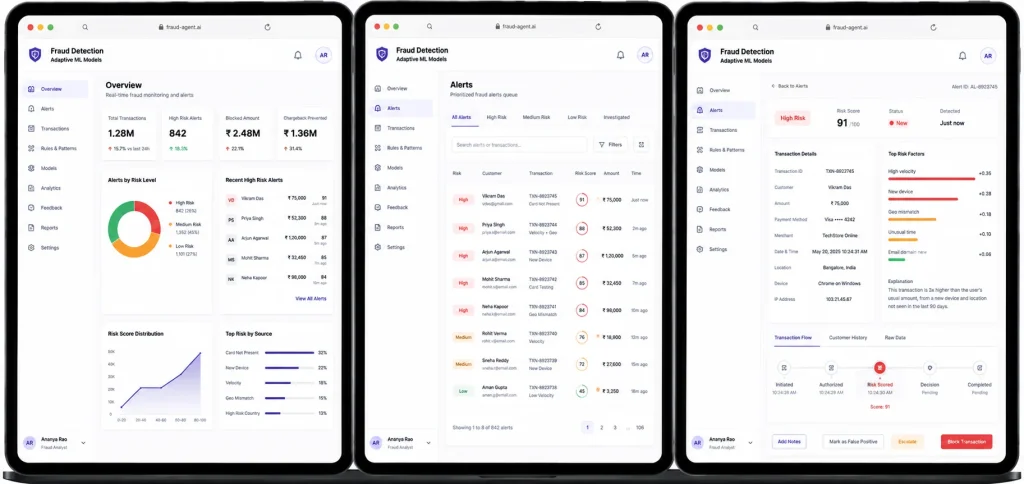
Adaptive AI Fraud Detection: Real-Time Transaction Risk Management
Vertical: Risk & Fraud Management
Tagline: Fraud models tuned to your transactions, not someone else’s.
Adaptive AI fraud detection helps payment platforms and lenders identify suspicious transactions while reducing unnecessary false positives. Instead of relying on generic fraud rules, the system learns from an organization’s own transaction patterns, analyst feedback, and labeled outcomes.
The Problem: Generic Fraud Models Miss the Context
Off-the-shelf fraud solutions can be expensive and difficult to customize. More importantly, they may not understand the transaction patterns of regional payment platforms, microfinance lenders, or niche SME payment flows.
As a result, legitimate transactions can trigger unnecessary alerts while some unusual activity may require additional investigation.
Businesses need a fraud detection approach that adapts to their own customers, transactions, and risk patterns.
An adaptive AI fraud detection system addresses this challenge by combining machine learning, transaction rules, real-time scoring, and continuous analyst feedback.
Key Features
Real-Time Transaction Risk Scoring
The system evaluates transactions as they arrive and assigns a risk score based on relevant transaction patterns.
It can also show the main factors that contributed to the score. Therefore, fraud analysts can understand why the system flagged a transaction instead of relying on a black-box decision.
Velocity and Pattern Detection
The system monitors transaction behavior across multiple dimensions. For example, it can identify:
- Multiple transactions within a short period
- Unusual transaction velocity
- Geographic mismatches
- Device anomalies
- Changes in normal customer behavior
- Unusual transaction sequences
These signals help the model detect suspicious behavior that simple rules may miss.
Analyst Feedback Loop
Fraud analysts can review alerts and mark each outcome as legitimate, suspicious, or fraudulent.
The system then uses these labeled outcomes as feedback. Consequently, the fraud model can improve as the organization collects more relevant transaction data.
Periodic Model Retraining
The system can retrain models using newly labeled transaction outcomes. This helps the detection system adapt as fraud patterns change over time.
For example, a pattern that was previously uncommon may become more frequent. Regular retraining allows the model to account for these changes.
Role-Based Fraud Intelligence
The platform provides focused tools for different teams:
- Fraud Analyst: Prioritized alert queue and transaction investigation.
- Risk Manager: Fraud trends, risk patterns, and performance dashboards.
- Data Team: Retraining pipelines, model evaluation, and model versioning.
How Adaptive AI Fraud Detection Works
The workflow is designed to keep transaction scoring fast while creating a continuous feedback loop.
- Receive transaction data: A transaction stream sends relevant data to the scoring API in near real time.
- Analyze risk signals: The system evaluates transaction behavior, velocity, location, device information, and other available signals.
- Score the transaction: The model assigns a risk score based on the available evidence.
- Explain the result: The system highlights the main factors that contributed to a high-risk score.
- Review alerts: Fraud analysts investigate prioritized transactions and record the outcome.
- Learn from feedback: The system uses labeled outcomes to retrain and improve future detection.
Technology Behind the Solution
The platform can combine supervised machine learning with anomaly detection and real-time data processing.
For example, XGBoost and LightGBM can support transaction classification and risk scoring. Both are widely used gradient-boosting frameworks. XGBoost documentation and LightGBM documentation provide technical details on these approaches.
For unusual transaction behavior, isolation forest models can help identify potential anomalies without requiring every pattern to have a fraud label.
The real-time architecture can use Kafka for transaction streaming and Redis for fast data access. The scoring layer can run through FastAPI, while MLflow can support experiment tracking and model lifecycle management. MLflow documentation provides guidance on tracking machine learning experiments and model information.
A typical technology stack can include:
- XGBoost or LightGBM for transaction risk scoring
- Isolation Forest for anomaly detection
- Kafka for transaction streaming
- Redis for low-latency data access
- FastAPI for the scoring API
- MLflow for model tracking and versioning
Why Adaptive Fraud Detection Matters
Fraud patterns change over time. A model that performs well today may become less effective as customer behavior, payment methods, and fraud tactics evolve.
Therefore, businesses need more than a static set of fraud rules.
An adaptive approach creates a continuous learning cycle. The system scores transactions, analysts review alerts, outcomes become new training data, and the models improve with additional evidence.
For payment platforms and lenders, this can help reduce unnecessary alerts while maintaining strong visibility into emerging fraud patterns.
Learn more about how Anthrobet approaches this use case with our Adaptive AI Fraud Detection Models.
Ideal For
Adaptive AI fraud detection is particularly useful for:
- Regional payment gateways
- Microfinance lenders
- SME payment platforms
- Digital payment providers
- Fintech companies with specialized transaction flows
- Risk teams managing high transaction volumes
From Static Rules to Adaptive Fraud Intelligence
Fraud detection does not need to rely entirely on fixed rules or expensive enterprise platforms.
Instead, an AI-powered system can combine transaction scoring, anomaly detection, explainable risk signals, and analyst feedback.
As transaction data grows, the system can learn from real outcomes and adapt to changing behavior.
For organizations with specialized payment flows, this approach provides a practical path toward more responsive and context-aware fraud management.
The goal is simple: detect suspicious activity earlier, reduce unnecessary alerts, and continuously improve fraud detection accuracy.