
AI Reconciliation Agent: Automate Transaction Matching and Exception Handling
Vertical: Finance & Operations
Tagline: Turn multi-day reconciliation into a same-day process.
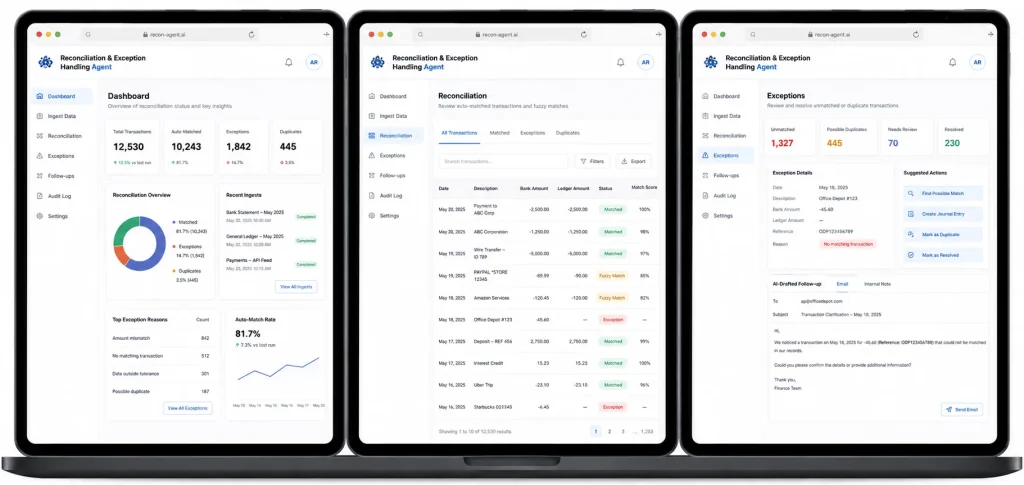
An AI reconciliation agent helps finance and operations teams automate transaction matching across ledgers, bank statements, invoices, and payment records. Instead of manually comparing thousands of transactions, the agent matches records, identifies exceptions, and helps teams resolve discrepancies faster.
As a result, finance teams can reduce repetitive reconciliation work while maintaining a clear and traceable audit trail.
The Problem: Manual Reconciliation Slows Finance Teams Down
Financial reconciliation becomes increasingly difficult as transaction volumes grow.
Finance teams may need to compare bank transactions against accounting ledgers, invoices, payment records, and other financial data. Small differences in amounts, dates, references, or transaction descriptions can prevent an automatic match.
Consequently, analysts spend hours investigating exceptions that could otherwise be resolved automatically.
Manual reconciliation also creates another challenge. Teams need to maintain a clear record of which transactions were matched, which rules were applied, and which items required manual intervention.
An AI reconciliation agent brings these activities into a single workflow.
Key Features
Automated Transaction Matching
The agent compares transactions across connected ledgers, bank feeds, invoices, and payment systems.
It can match records using:
- Transaction amount
- Transaction date
- Reference number
- Invoice number
- Counterparty information
- Transaction descriptions
The system can also use fuzzy matching when fields do not match exactly.
For example, a bank reference may contain additional characters or a slightly different description from the corresponding ledger entry. The matching engine can identify these similarities and suggest a match for review.
Intelligent Exception Detection
Not every transaction will have a clear match.
The system flags:
- Unmatched transactions
- Duplicate entries
- Amount mismatches
- Date mismatches
- Missing references
- Unexpected transaction patterns
Finance teams can then prioritize exceptions instead of manually checking every transaction.
Exception Management Dashboard
Ops managers can access a centralized exception queue.
They can filter discrepancies by account, transaction type, date range, or exception category. Each exception can then be opened for a detailed review.
This gives teams a clear view of outstanding reconciliation work.
Complete Audit Trail
The system records reconciliation activity, including:
- Matching rules applied
- Match timestamps
- Transaction status
- Reviewer actions
- Manual overrides
- Exception resolutions
As a result, auditors and compliance teams can trace how a transaction reached its final reconciliation status.
Automated Follow-Up Emails
Some discrepancies require information from vendors, customers, or other counterparties.
The agent can prepare follow-up emails for unresolved items. Finance or operations teams can then review and send the messages instead of drafting each request manually.
How the AI Reconciliation Agent Works
The workflow combines automated matching with human review for exceptions.
- Ingest financial data: The system collects transactions from bank feeds, accounting systems, invoices, and other connected sources.
- Normalize records: The agent standardizes fields such as dates, amounts, references, and transaction descriptions.
- Match transactions: The matching engine compares records and identifies likely matches.
- Score exceptions: Unmatched or unusual transactions receive an exception or anomaly score.
- Route exceptions: Low-confidence matches, duplicates, and discrepancies move to the exception dashboard.
- Review and resolve: Finance or operations users approve matches, correct records, or investigate discrepancies.
- Record the outcome: The system stores the final status and creates an audit trail.
- Follow up: Where required, the agent prepares messages for vendors or counterparties.
Why Automated Reconciliation Matters
Month-end reconciliation can become a major operational bottleneck for financial businesses.
For NBFCs, payment aggregators, and SME lenders, the challenge becomes even greater when teams manage large transaction volumes across multiple accounts.
An AI reconciliation agent can automate the straightforward matches while directing exceptions to the right person.
Therefore, finance teams can spend less time comparing records manually and more time investigating the discrepancies that actually require attention.
The approach also supports a more consistent reconciliation process. Instead of relying on individual analysts to remember matching rules, the system can apply defined rules and matching logic consistently.
Who It’s For
Finance and Accounts Teams
Finance analysts can automate transaction matching across ledger and bank feeds. They can also investigate fuzzy matches and resolve exceptions from one workspace.
Ops Managers
Operations teams can monitor outstanding discrepancies through an exception dashboard. They can drill down by account, transaction type, or date range.
Auditors and Compliance Teams
Auditors can access a complete reconciliation trail showing rules, timestamps, decisions, and manual overrides.
Vendor and Counterparty Teams
Teams responsible for external follow-ups can use automatically drafted emails to request missing information or clarification.
Technology Behind the Solution
An AI reconciliation agent can combine rules-based matching, fuzzy matching, machine learning, and workflow automation.
A typical technology stack can include:
- CSV and Excel data parsers
- Bank API connectors
- Python with pandas for transaction processing
- RapidFuzz for fuzzy string matching
- Rules engines for deterministic matching
- Gradient boosting for anomaly scoring
- FastAPI or Node.js for backend services
- PostgreSQL for transaction storage
- React for the exception dashboard
- AWS, Azure, or Google Cloud for infrastructure
- Docker for containerized deployment
For example, pandas provides data analysis tools for Python, while RapidFuzz provides efficient fuzzy string matching capabilities.
For cloud deployments, AWS provides architecture guidance for building scalable cloud applications.
AI Matching With Human Oversight
Automation does not mean every reconciliation decision should happen without human review.
Some transactions may have multiple possible matches or unusual circumstances. In these cases, the system can present the best available match and explain why it was suggested.
A finance analyst can then approve, reject, or modify the result.
Over time, historical outcomes can also provide useful data for improving anomaly detection and identifying recurring mismatch patterns.
This creates a practical workflow:
Match → Detect → Review → Resolve → Learn
Business Impact
An AI reconciliation agent can help organizations achieve:
- 60–80% reduction in manual reconciliation hours, depending on transaction quality and workflow design
- Faster month-end and period-end close
- Fewer repetitive matching tasks
- Faster exception resolution
- Consistent reconciliation rules
- Better visibility into outstanding discrepancies
- Audit-ready reconciliation records
Actual results will vary based on transaction volume, data quality, integration coverage, and the complexity of the reconciliation process.
Ideal For
This solution is particularly useful for:
- NBFC finance teams
- Payment aggregators
- SME lenders
- Controllers
- Audit and compliance teams
- Finance operations teams
- Businesses managing multiple bank accounts
- Organizations processing high transaction volumes
From Manual Reconciliation to Intelligent Exception Management
Reconciliation should not require finance teams to manually compare every transaction.
Instead, an AI reconciliation agent can handle routine matches, identify exceptions, and direct unresolved items to the right person.
This allows finance teams to focus on exceptions that require judgment while the system handles repetitive matching work in the background.
For organizations exploring where AI can reduce manual finance and operations work, book an AI audit with Anthrobet.
The goal is simple: reconcile transactions faster, resolve exceptions sooner, and maintain a clear audit trail from match to resolution.