
AI Data Labeling: Faster Training Data With Human-in-the-Loop Review
Vertical: Data & ML Operations
Tagline: First-pass AI labeling, human review only where it matters.
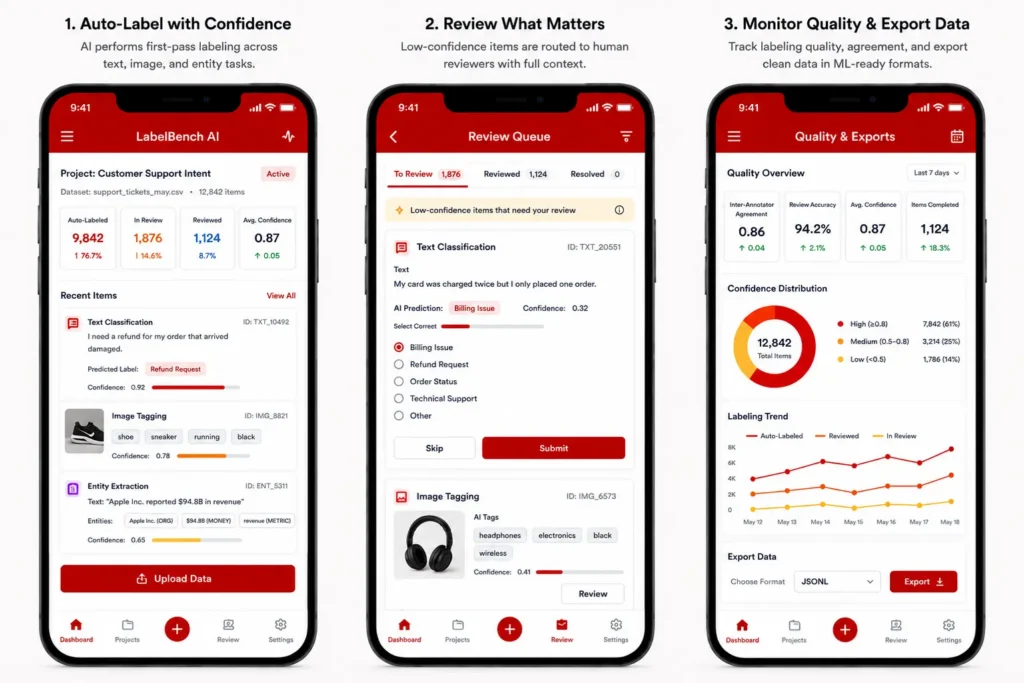
AI data labeling helps machine learning teams create high-quality training data faster. Instead of sending every item to a human annotator, the system performs a first-pass labeling step and assigns a confidence score to each result.
Low-confidence items then move to human reviewers. Meanwhile, high-confidence items can continue through the workflow with less manual effort.
This creates a practical middle ground between slow human-only labeling and unreliable AI-only labeling.
The Problem: Data Labeling Is Slow and Expensive
Machine learning teams need clean, accurately labeled data to train and fine-tune models. However, labeling large datasets manually can take significant time and resources.
On the other hand, fully automated labeling can introduce mistakes that are difficult to detect. These errors may then reach downstream training pipelines and affect model performance.
As a result, teams often face a difficult choice: accept higher labeling costs or risk lower data quality.
An AI data labeling workflow solves this problem by combining automated first-pass labeling with targeted human review.
Key Features
Automated First-Pass Labeling
The system can label different types of data, including:
- Text classification
- Image tagging
- Entity extraction
- Document classification
- Custom business-specific categories
The AI performs the initial labeling and assigns a confidence score to each item. Therefore, teams can process large datasets without sending every item directly to a human reviewer.
Confidence-Based Human Review
Not every prediction requires manual inspection.
The system routes low-confidence items to human reviewers while allowing high-confidence results to continue through the workflow.
This approach helps teams focus human effort where it provides the most value.
Inter-Annotator Agreement Tracking
For human-reviewed datasets, the platform can track agreement between annotators.
This helps ML teams identify unclear labeling guidelines, inconsistent decisions, and difficult edge cases. Consequently, teams can improve their annotation process and maintain better dataset quality.
Custom Labeling Schemas
Every ML project has different requirements. The platform therefore supports client-defined taxonomies, labeling rules, and edge-case instructions.
Teams can adapt the labeling workflow to their own model and business requirements instead of using a fixed annotation structure.
Reviewer Dashboard
Human reviewers can inspect low-confidence items through a centralized dashboard.
They can correct labels, provide feedback, and resolve edge cases. The system then feeds these corrections back into the learning workflow.
Standard ML Exports
Once labeling is complete, teams can export datasets in commonly used machine learning formats such as JSON and COCO.
The COCO dataset is widely used for computer vision tasks and includes annotation formats for tasks such as object detection and segmentation.
How AI Data Labeling Works
The workflow combines automation with human quality control.
- Upload the dataset: The client provides the raw dataset along with labeling guidelines and the required schema.
- Run first-pass labeling: The AI analyzes each item and generates an initial label.
- Calculate confidence: The system assigns a confidence score to each prediction.
- Route exceptions: Low-confidence items move to the human review dashboard.
- Correct labels: Reviewers approve, reject, or modify AI-generated labels.
- Learn from feedback: Corrections become useful feedback for improving future predictions and confidence calibration.
- Export the dataset: The completed dataset moves into the required ML format for training or fine-tuning.
Why Human-in-the-Loop Labeling Matters
AI can accelerate data labeling, but automation does not remove the need for quality control.
Some examples are easy for a model to classify. Others may contain ambiguous language, unusual images, overlapping categories, or business-specific edge cases.
Therefore, sending every item through human review can waste time, while accepting every AI prediction can introduce hidden errors.
A confidence-based workflow offers a better balance. The AI handles routine cases, while human reviewers focus on uncertain or important examples.
Over time, reviewer corrections can also help improve the labeling workflow. This creates a continuous feedback loop between the model and the people responsible for data quality.
Technology Behind the Solution
The platform can combine large language models, machine learning, active learning, and a dedicated reviewer interface.
For example, Claude can support classification and extraction tasks through the Anthropic API documentation. The system can then combine model outputs with confidence calibration and project-specific labeling rules.
A typical technology stack can include:
- Claude API for classification and extraction
- Active-learning confidence calibration
- Custom labeling schemas and taxonomies
- Reviewer web dashboard
- Feedback-to-model workflows
- Standard ML dataset export pipelines
- JSON and COCO-compatible outputs
The architecture can also support model versioning and dataset versioning. As a result, ML teams can track changes to their labeling process and understand which version produced a particular dataset.
Benefits for ML Teams
A well-designed AI data labeling workflow can help teams:
- Process larger datasets faster
- Reduce repetitive manual labeling
- Focus reviewers on uncertain cases
- Improve annotation consistency
- Capture reviewer feedback
- Support custom labeling requirements
- Prepare datasets for model training and fine-tuning
Most importantly, teams can increase labeling throughput without treating AI predictions as automatically correct.
Ideal For
AI data labeling is particularly useful for:
- ML engineering teams
- AI startups
- Computer vision teams
- NLP teams
- Companies fine-tuning foundation models
- Organizations building domain-specific AI systems
- Teams working with large proprietary datasets
From Manual Labeling to Intelligent Data Operations
High-quality training data remains one of the most important parts of building reliable machine learning systems.
However, teams do not have to choose between fully manual labeling and fully automated labeling.
Instead, an intelligent workflow can let AI handle the first pass while human reviewers focus on uncertain cases. Over time, reviewer feedback can help improve the labeling process and confidence calibration.
For a deeper look at this solution, explore Anthrobet’s LabelBench AI – Automated Data Labeling.
The goal is simple: label data faster, keep humans focused on the cases that matter, and build cleaner datasets for better AI models.