
AI Customer Support Agent: Smarter Support With Human Handoff
Vertical: Customer Service / SaaS & E-commerce Support
Tagline: A support bot that knows when to stop being a bot.
An AI customer support agent helps SaaS and e-commerce businesses resolve routine customer questions while knowing when a human needs to step in. Instead of forcing customers through endless chatbot loops, the agent uses intent, confidence, and sentiment signals to decide when to resolve a request and when to escalate it.
As a result, businesses can automate common support tasks without sacrificing the human experience.
The Problem: Chatbots Often Fail When Conversations Get Complex
Most customer-facing chatbots can handle simple questions. For example, they may provide order status, return information, billing details, or answers to common FAQs.
However, real customer conversations are not always straightforward.
A customer may have an unusual billing issue, a delayed order, or a problem that requires judgment. When a chatbot cannot handle the situation, it may repeat the same response or send the customer through an endless loop.
This creates frustration and can damage customer trust.
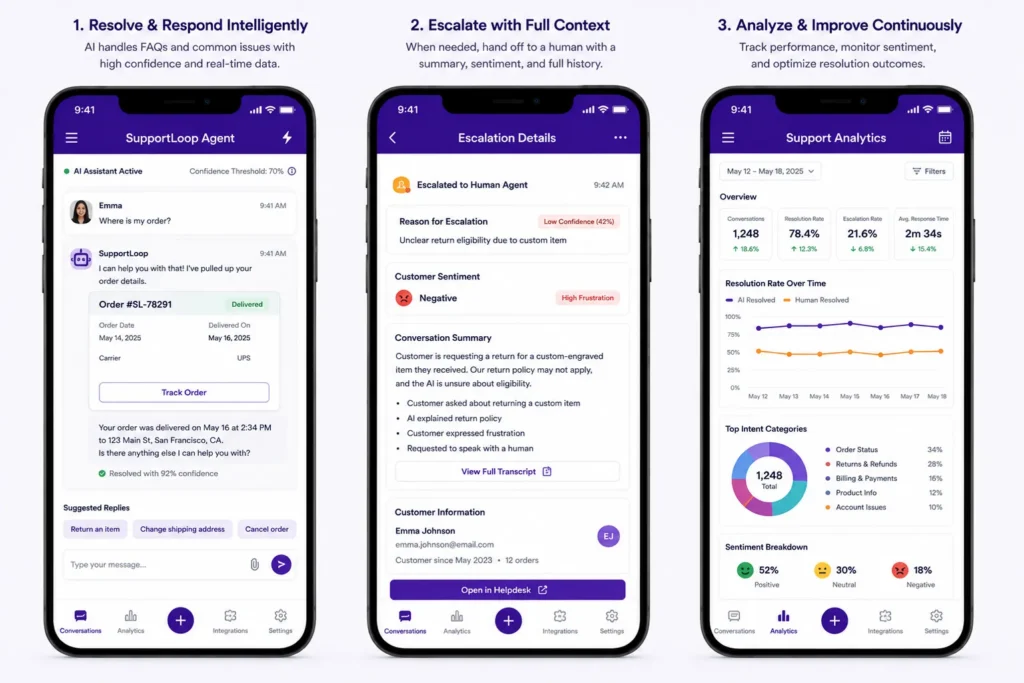
An AI customer support agent takes a different approach. It resolves routine requests when confidence is high and escalates complex or sensitive conversations to a human when necessary.
Key Features
Tier-1 Customer Support
The agent can handle common support requests such as:
- Order status
- Returns and exchanges
- Billing questions
- Product FAQs
- Account questions
- Basic troubleshooting
Therefore, support teams can automate repetitive conversations while keeping human agents available for more complex cases.
Context-Aware Human Handoff
Escalation should not mean starting the conversation again.
When the agent hands a conversation to a human, it can provide the full conversation history along with a concise summary of the customer’s issue.
The human agent can then continue from the existing conversation instead of asking the customer to repeat information.
Confidence-Based Routing
The system assigns a confidence score to each response.
If confidence is high and the request falls within an approved support workflow, the agent can respond directly.
If confidence is low, the conversation can move to a human agent instead.
This creates a simple principle:
High confidence → AI resolves
Low confidence → Human reviews
Sentiment Detection
Some conversations require human attention even when the question itself is technically simple.
The system can detect signals of frustration or negative sentiment and prioritize those conversations for human support.
For example, a customer who has contacted support several times about the same unresolved issue can be routed to a human faster.
Helpdesk Integrations
The agent can connect with existing customer support platforms rather than forcing businesses to replace their current systems.
Supported integrations can include:
- Zendesk
- Intercom
- Freshdesk
- Chat and email support channels
- Existing ticketing workflows
For example, Zendesk’s developer documentation provides resources for integrating applications with Zendesk support workflows. Intercom’s developer documentation provides similar resources for building integrations with Intercom.
Support Analytics
Managers can monitor important support metrics from a centralized dashboard.
These can include:
- AI resolution rate
- Human escalation rate
- Average response time
- Escalation reasons
- Customer sentiment
- Support volume
- Unresolved conversations
As a result, teams can identify where automation is working and where customers still need more human support.
How the AI Customer Support Agent Works
The workflow is designed to automate simple requests while providing a smooth human handoff when needed.
- Receive the customer message: A customer contacts the business through chat, email, or an integrated helpdesk.
- Understand the request: The agent identifies the customer’s intent and retrieves relevant information.
- Assess confidence: The system evaluates whether it has enough information to provide a reliable response.
- Resolve routine requests: If confidence is high, the agent responds within the approved support workflow.
- Detect escalation signals: Low confidence, complex requests, or strong negative sentiment can trigger escalation.
- Create a context summary: The agent prepares a concise summary of the issue and includes the relevant conversation history.
- Hand off to a human: A support agent receives the conversation without requiring the customer to repeat the problem.
Why Human Handoff Matters
Customer support automation should not be measured only by how many conversations a bot can handle.
The quality of the escalation matters just as much.
A chatbot that resolves 60% of simple questions but frustrates customers during the remaining 40% may create a poor overall experience.
An AI customer support agent can take a more balanced approach. It handles repetitive requests while recognizing its own limits.
When the system cannot confidently resolve an issue, it moves the conversation to a human with the relevant context already prepared.
This creates a better support workflow:
Understand → Resolve → Detect Uncertainty → Summarize → Escalate
Technology Behind the Solution
A typical architecture can combine a large language model, helpdesk integrations, confidence scoring, sentiment analysis, and a human-in-the-loop workflow.
The technology stack can include:
- Claude API for intent classification and response generation
- Zendesk, Intercom, or Freshdesk APIs
- Confidence scoring and routing logic
- Sentiment detection
- Human escalation queue
- Customer conversation database
- FastAPI or Node.js backend
- React-based support analytics dashboard
The Anthropic API documentation provides resources for integrating Claude into AI applications.
For helpdesk integrations, businesses can use the APIs provided by their existing customer support platforms. This allows the AI agent to work alongside existing ticketing and customer service processes.
Benefits for SaaS and E-commerce Businesses
An AI customer support agent can help businesses:
- Automate repetitive Tier-1 support
- Reduce response times
- Provide support outside business hours
- Reduce unnecessary chatbot escalations
- Give human agents full conversation context
- Prioritize frustrated customers
- Improve support team productivity
- Identify recurring customer issues
Most importantly, businesses can automate support without treating every customer conversation as a problem that a bot must solve alone.
Ideal For
This solution is particularly useful for:
- E-commerce businesses
- SaaS companies
- Online retailers
- Subscription businesses
- Digital product companies
- Small and mid-sized support teams
- Businesses currently using generic chatbots
- Companies transitioning from fully manual customer support
From Chatbot Automation to Intelligent Customer Support
The future of customer support is not simply about replacing human agents with bots.
Instead, the better approach is to let AI handle the conversations it can resolve confidently and involve people when their judgment matters.
An AI customer support agent creates exactly this balance.
It can answer routine questions, understand when a conversation is becoming complex, detect customer frustration, and provide a human agent with the context needed to continue the conversation.
For businesses exploring where AI can automate customer-facing workflows and improve operational efficiency, book an AI audit with Anthrobet.
The goal is simple: resolve more routine questions with AI, escalate the right conversations to humans, and never make customers repeat themselves.